International 8 Ball Referee

International Eight Ball Pool Rules

International Eight Ball Pool Rules

International Eight Ball Pool Rules, Revision 2d (December 2025), as endorsed by the IEPF and Ultimate Pool.

Contents

1. Spirit of the Game

The game shall be known as ‘International eightball pool’ with rules that must be played in a sporting manner at all times.

2. Equipment & Table Layout

All equipment that is generally accepted throughout the industry is permitted. No other equipment is allowed unless ratified by the Tournament Director.

However, using any equipment in a non-customary manner is never allowed and constitutes a foul.

International eight-ball pool is played on a six-pocket rectangular table with six cushions.

Equipment permitted:

  • (a) A white called a cue ball
  • (b) Two groups of object balls consisting of seven reds and seven yellows
  • (c) An eight-ball
  • (d) Spider, rest, gooseneck rest, cross rest
  • (e) Prescribed cues

The playing surface is the flat part of the table bordered by the cushions.

The surface must be marked with an eight-ball spot at the intersection of two imaginary diagonal lines joining the centre and corner pockets.

The surface must be marked with a ‘rack line’. The rack line must be a 280mm vertical line going down through the eight-ball spot towards the top cushion (See Rule 5 for an illustration of the rack line). On the rack line must be two marker points, one for the head ball and the other for the eight-ball.

The cloth is marked with a break line parallel to the bottom cushion 1/5th of the length of the table away from the baulk cushion.

3. The Object of the Game

International eight-ball pool is played with a cue ball and fifteen object balls, seven red, seven yellow and an eight-ball. One player must pocket all balls of one group, while the other player must pocket the alternate coloured balls. The player who pockets their entire group and THEN legally pockets the eight-ball wins the game. The eight-ball must be potted in a separate shot.

4. The Break

4a – A “Lag for Break” shall determine who breaks first with an alternating break format taking place thereafter. The winner of the lag is the player whose ball is closest to the baulk cushion. The winner of the lag is given the choice to break or not.

4b – Lagging Procedure: (guidance, what should happen)

  • (1) Balls shall be of equal size and weight
  • (2) To start the lag the referee will count the players in by counting back from 3 to 1.
  • (3) The players shall simultaneously strike balls on the referee’s indication towards the top cushion.

4c – It is an automatic loss of lag if a ball:

  • (1) Crosses into the opponent’s half of the playing surface OR
  • (2) Fails to contact the top cushion OR
  • (3) Drops into a pocket OR
  • (4) Hits a side cushion OR
  • (5) Jumps off the table OR
  • (6) Comes to rest on the playing surface within the area of the corner pocket OR
  • (7) Player commits any standard foul

4d – Players will lag again if:

  • (1) Both players foul OR
  • (2) The referee is unable to decide on which ball is closest to the bottom cushion OR
  • (3) One player’s ball strikes the top cushion before the other player’s ball is hit.

4e – To commence a frame, the player who is breaking, shall position the cue ball anywhere in baulk but MUST NOT position the cue ball over the break line by more than 50% of its diameter.

4f – The Break will be deemed a ‘Legal Break’ if the player breaking, obtains a minimum of three cumulative points.

  • 1 point for each object ball potted (eight-ball included).
  • 1 point for each object ball that has passed an imaginary line between the two centre pockets, that is not potted. A ball is deemed as having ‘passed’ the centre line if the whole ball is over the imaginary line.

4g – Failure to perform a legal break MUST result in a re-rack. The opponent has the option to break or to choose to give the break back to the original breaker.

4h – Groups are not decided on the break. The table remains open after the break. If the player in control of the table does not make a legal pot, the table is still deemed open for the incoming player.

4i – If the eight-ball is potted off the break, it is always re-spotted after all balls have come to rest on the table. To re-spot the eight-ball, the centre point of the eight-ball is placed on the eight-ball spot or if this is not available as near as possible to the spot in a direct line between the spot and the centre of the top cushion.

If there is no space available on this line, place the eight-ball as near as possible to its spot in a direct line between the spot and the bottom cushion.

If the eight-ball is the ‘only ball potted on a legal break’ then control of the table goes to the incoming player. If it’s potted with other groups and the criteria of a legal break has been fulfilled, the breaker continues.

4j – If the cue ball, on a legal break:

  • (1) Goes “in-off”, a loss of turn occurs and the incoming player is awarded one visit with cue ball in hand, to be played from baulk, in any direction.
  • (2) Leaves the playing surface, a standard foul will be called against the breaker, with the incoming player receiving one visit, played from anywhere on the playing surface. (See Rule 6l (1))

5. The Rack

Arrange as shown with the eight-ball on the eight-ball spot. Top apex ball on the head marker of the rack line.

6. In Play

6a. Deciding Groups

(1) Groups are decided on the first ball legally potted. The referee will call the first group in play.

(2) The table is considered an “open” table when the choice of groups (red or yellow) has not yet been determined. The table is always open immediately after the break shot. Balls potted from the break are disregarded. The player’s designated group (red or yellow) will not be determined until a player legally pockets an object ball. Once groups are determined, object balls from a player’s group are referred to as ‘on’ ball(s).

(3) Failure to make a legal pot will result in the table remaining open.

(4) If one of each group is potted in one shot, the player will be ‘on’ the group struck by the cue ball first unless a foul has occurred, in which case the table remains open.

(5) Where the choice of group is not obvious. (e.g. player cues up to a group of object balls OR object balls of both groups sitting close to each other OR player is snookered behind the eight-ball OR the lay of the table is such no object ball is a clear target).

  • (a) The player MUST indicate to the referee and/or the opponent the intended group.
  • (b) Failure to call a group, after potting a ball, whilst the table is open, is loss of turn (See Rule 6d), the table remains open.
  • (c) Failure to strike called group is loss of turn (See Rule 6d), the table remains open.
  • (d) Striking a called group but potting the other group is loss of turn (See Rule 6d), the table remains open.
  • (e) Potting a called group is a legal pot and the group is assigned to the striker.
  • (f) The onus is on the player in control of the table, to make a call for the groups to be decided in a fair and sporting manner.

(6) Groups are not decided on a foul shot.

(7) In the event of a touching ball, you MUST indicate to the referee and/or opponent the intended group. See Rule 6o (2).

6b. Continuing a Frame

In the course of play, if a legal shot is played and the ball(s) from the player’s own group are potted, play continues and the player is entitled to an additional shot. The player will lose their turn and return control of the table to the opponent if they:

  • (a) Fail to pot one or more of their own group AND / OR
  • (b) Commits a standard foul.

6c. Combination Shots

Object balls from both groups can be potted without penalty in a single ‘combination’ shot. Combination shots do not have to be called. The potted balls may drop into the pockets in any order but ‘on’ ball must be struck legally first. Attempting to complete a combination shot that results in only potting ball not ‘on’ is LOSS OF TURN.

6d. Loss of Turn

As long as the player strikes an ‘on’ ball first, should an opponent’s ball be potted without also potting an ‘on’ ball, it will be loss of turn. Control of the table returns to the opponent; the cue ball is played from where it lies.

The only exception to this is during an open table where the choice of groups has yet to be decided, see point (4) below.

For example:

  • (1) Potting an opponent’s ball accidentally.
  • (2) Failing to complete a legal combination shot.
  • (3) A tactical shot e.g. playing a designated group legally to pot an opponent’s ball.
  • (4) Failure to call a group after potting a ball, whilst the table is ‘open’, if the group was not obvious.

6e. Standard Fouls

Shall be called as soon as they occur, the fouling player is in control until all balls from that shot have come to rest. The incoming player is awarded one visit and a cue ball in hand, which can be:

  • (a) Played from its current position, or
  • (b) Placed anywhere on the playing surface.

The only exception to (a) is if the cue ball has come to rest and is touching an object ball and therefore must be repositioned. Failure to reposition the cue ball, if touching ball is declared, will result in a standard foul as per rule 6e (7).

Standard fouls are:

(1) Potting the cue ball – “In Off” (Except off the break – See rule 4j)

(2) Playing from outside baulk when obliged to play from Baulk. The break line is considered to be part of the baulk. (See rule 4e)

(3) A player who plays a shot immediately after playing a foul or immediately after the referee has called a foul on that player, has played out of turn. This also covers breaking out of turn.

(4) Accidentally striking the cue ball with any part of the cue other than the tip in general play. Positioning the cue ball with the cue is allowed as long as the tip of the cue is not used.

(5) Accidentally striking any ball other than the cue ball with any part of the cue or cue tip.

(6) Playing a shot before all balls have come to rest from the previous shot.

(7) Playing a shot before any balls that require re-spotting or replacing, have been re-spotted or replaced. (See Rule 6m).

(8) Coaching: During a frame, a player is required to play without receiving any advice from other persons relating to the playing of the frame. If a team member or bona fide supporter of a player offers advice, the referee will issue a “First and final warning” to that person that a repetition will result in the player being penalised via a standard foul. Because it may not always be possible for the referee to hear if a statement made to a player is advice, the referee may issue the first and final warning because any statement made to a player, other than general barracking, is deemed to be coaching. In a tournament setting, a first and final warning may be given once only, before the commencement of the day’s play as a block warning to all players and spectators.

(9) Leaving the playing area without permission. If a player needs to leave the playing area during a frame or match, “Timeout” must first be granted by the referee.

A timeout may be called for:

  • (a) When a player requests a rest or bridge OR
  • (b) Something or someone is obstructing the player OR
  • (c) The referee has to make a decision OR
  • (d) The referee has to replace or re-spot a ball.

(10) Playing a ‘Push Shot’ (defined as when the tip of the cue remains in contact with the cue ball once it has commenced a forward motion).

(11) Double-hitting the cue ball.

(12) Failing to perform a ‘Legal Shot’.

(13) Playing a shot while not having at least one foot touching the floor.

(14) Failing to “Play Away” from a touching ball(s).

(15) A ball that remains off the playing surface.

(16) A player’s body, clothing, jewellery or accessory, or part of a cue (except for the tip in a legal shot), comes into contact with any ball. A tip falling off a cue or chalk dropped is the player’s responsibility. Should any of these contact a ball on the playing surface, it is deemed a foul. A player is responsible for their ‘own’ equipment brought to the table but not that which is ‘supplied’ by the competition itself. For example, if the end falls off a rest that has been ‘supplied’ by the competition which contacts a ball, this is deemed not a foul.

(17) Jump shot: If the cue ball leaves the bed of the playing surface and does not strike an object ball that it would have struck had the cue ball not left the playing surface on an otherwise identical shot, then the cue ball is deemed to have jumped over that ball.

(18) Marking the table to assist a shot.

(19) Time foul.

6f. Loss of Frame Fouls

(1) Deliberately not playing a ball from their own group first, or an “on” ball after a foul.

(2) Unsporting behaviour / bringing the game into disrepute.

Including but not exclusive to:

  • (a) A second offence for Foul language (A verbal warning is given for the first offence) OR
  • (b) Throwing a cue around / unscrewing as if to concede OR
  • (c) Continually arguing with the referee or opponent OR
  • (d) Interfering when the opponent is on the shot either verbally or physically.

(3) Committing a foul in the same shot that the eight-ball is potted. (Except on the break)

(4) Potting the eight-ball when a ball or balls of the player’s own group are still on the table. (Except on the Break) Including potting the last group ball and eight-ball in the same shot.

(5) A player who clearly and intentionally fails to make an attempt to play a ball(s) of their own group.

(6) Potting the eight-ball legally, then proceed to move the remaining balls before they have come to rest.

(7) Deliberately striking the cue ball with any part of the cue other than the tip in general play. Positioning the cue ball with the cue is allowed as long as the tip of the cue is not used.

(8) Deliberately striking any ball other than the cue ball with any part of the cue or cue tip.

(9) Deliberately moving a ball(s) other than playing as part of a shot.

6g. Stalemate Situation

If any situation arises whereby a ‘legal shot’ (see Rule 6e (12)) cannot be played, it is a player’s responsibility to ask for a stalemate. In other words, if there is not a path ‘out’ for the cue ball or not a path ‘into’ the ball ‘on’, in the first instance the player must ask for a stalemate if they believe a ‘legal shot’ cannot be played. A decision on whether a stalemate exists will be at the referee’s discretion. A referee will disregard a player’s ability when making a stalemate decision.

If the referee (or opponent – if no referee) confirms a stalemate, the frame shall be restarted with a re-rack. The player who originally broke will restart the re-racked frame. If no stalemate is confirmed, the players must continue their visit.

6h. Frozen Balls

(1) An object ball is deemed frozen whilst touching a cushion. It is a standard foul if the cue ball initially contacts a frozen ball first and the shot does not result in:

  • (a) A ball being potted OR
  • (b) The cue ball contacting a cushion OR
  • (c) The frozen ball contacting a cushion attached to a different rail OR
  • (d) Any other object ball contacting a cushion, with which it was not already in contact with, before the shot is played.

(2) A ball is only deemed frozen if confirmed by the referee or player, prior to the shot being taken.

6i. Outside Interference

(1) There is no penalty if balls are moved in these circumstances:

  • (a) By persons other than players taking part in the frame OR
  • (b) As a result of players being bumped OR
  • (c) Events deemed not within a player’s control.

(2) The referee will return the balls as close as possible to their original positions whenever possible. Re-racks will only be granted in extreme circumstances. The referee’s decision is final.

(3) The referee can reset the shot clock if they consider the situation warrants. The decision is at the referee’s discretion.

6j. Shot Clock

Each player is allotted 45 seconds for each shot. The tip of the cue must have made contact with the cue ball within this time or a standard foul shall be granted to the opponent. The 45-second shot clock will commence once all balls come to rest. The timekeeper will verbally count down from 5 seconds.

One extension per frame is permitted per player, whereby the referee will add 15 seconds to the remaining time at the request of the player.

6k. Balls Falling into a Pocket

A shot is ‘complete’ when all balls have come to rest.

(1) After a shot is ‘complete’, any ball(s) that drops into a pocket, without being struck, will be replaced to their original positions.

A shot is ‘in progress’ when the cue ball has been struck and all the balls have not come to a rest.

(2) During a shot ‘in progress’, any ball(s) that drops into a pocket, without being struck and wouldn’t have been played as part of a shot, shall be replaced to their original positions after all balls have come to rest.

(3) During a shot ‘in progress’, any ball(s) that drops into a pocket, without being struck and would have been played as part of a shot, in this instance ALL BALLS will be replaced to their original positions after all balls have come to rest.

After the balls have been reset to their original positions, the original player will always continue with no penalty, unless:

  • (a) A foul had been committed or
  • (b) The original player failed to pot a ball ‘on’ (the exception to this is (3) where the original player will always continue).

6l. Balls off the Playing Surface

It is a ‘standard foul’ if a ball leaves the playing surface at any point during the frame AND does not return by its own means and remains off the playing surface (other than being potted)

  • (1) If it is the cue ball, then it is ball in hand, to be played anywhere on the table.
  • (2) Object balls are re-spotted (See Rule 6m).

6m. Returning Object Balls which Leave the Playing Surface that Remain off the Table

An object ball is re-spotted with its centre point on the eight-ball spot or as near as possible to that spot in a direct line between the spot and the centre point of the top cushion.

Object balls are re-spotted in the following order:

  • (a) Eight-ball
  • (b) Red
  • (c) Yellow

Return balls as close as possible to other balls without touching.

6n. Players’ Responsibility

It is the responsibility of each player to be aware of all rules. However, a referee on request may advise on the rules of the game but must not provide any subjective opinion that would affect the result of the frame. Tournament officials will make every reasonable effort to make the information readily available to all players. However, the ultimate responsibility rests with each individual player. There is no recourse if a player does not obtain correct or complete information.

Players may always call for rule(s) clarification during play. However, this is not considered as a “Timeout”.

6o. Touching Balls

(1) A player must play away from ‘ALL’ touching balls at an angle of perpendicular (90 degrees) or greater and fulfil the requirements of a ‘legal shot’. A player shall not be penalised if playing away from touching ball(s) causes any touching ball to rock or move slightly because it was ‘resting’ on the cue ball.

(2) If the table is ‘open’ and touching ball(s) have been confirmed, the player must, in the following order:

  • (a) Nominate a group. (This is for clarity of the shot, and not to decide a group for the remainder of the frame) See Rule 6a (1) on deciding groups.
  • (b) Perform all the requirements of a ‘legal shot’.

(3) If the groups have been decided and touching ball(s) has been confirmed, the player must perform all the requirements of a ‘legal shot’.

(4) If the cue ball is touching an ‘on’ ball, the player is deemed to have made ‘initial contact’ in order to fulfil the requirements of a ‘legal shot’.

Definition: To play a ‘legal shot’ the player must cause the cue ball’s initial contact to be with a ball ‘on’ and THEN must either:

  • (a) Pot any ball or balls (except the eight-ball if not ball ‘on’) OR
  • (b) Cause the cue ball or any object ball to contact a cushion.

The ‘cushion’ is defined as the six rails and the six pockets of a pool table.

6q. Simultaneous Contact

Simultaneous contact of object balls is allowed as long as one of the contacted object balls is ‘on’.

7. Completion of a Frame

A frame is over when the eight-ball is potted on a legal shot and all the balls have come to rest or in a ‘loss of frame’ situation.

Copyright © Lee Kendall
Compiled by International Referees Organisation
Revision 2d – December 2025

International Rules v2d (Dec 2025) A4 Booklet
http://aebf.asn.au/wp-content/uploads/sites/11/2026/10/IEB-Rules-Rev-2d-A4-Booklet.pdf

International Rules v2d (Dec 2025) A3 Poster http://aebf.asn.au/wp-content/uploads/sites/11/2026/10/IEB-Rules-Rev-2d-A3-Poster.pdf

6 Red

In the event of a tied match, each player will be faced with a mini-triangle of 6 red balls. They must break and pot all 6 reds in quick succession. Each player is timed on the shot clock. The quickest to clear all 6 reds in one go will win the match and progress to the next round.

6 Red Guidance.

Players to lag for the right to choose who will go first and second.
Proceed to rack the balls with the head ball on the head spot so that the middle ball of row three is on the black spot.

Explain to players.

The clock will start when they strike the cue ball.
The clock will stop when the last red leaves the playing surface, because it’s easier to see the final red ball go down the pocket than it is to know if the cue ball has stopped moving.

Players always have to play a legal shot, it’s a 5-second penalty for any foul (including any foul that occurs after the last red is potted), which is added onto the time at the end of a completed 6-red clearance.

The cue ball and intended red ball ‘on’ need to be stationary when striking the cue ball but all other red balls can be moving.

Always keep hold of the cue ball and have the stopwatch in hand ready, you can then CALL: In your own time (Players forename).

First player’s attempt.

Start the timer on the stopwatch as they strike the cue ball.

Stop/pause the timer on the stopwatch as the last red leaves the bed of the table.

Record the time and add any additional penalties if necessary. Check for any unsure fouls by way of VAR and/or a second referee (if either is present).

Second player’s attempt.

Start the timer on the stopwatch as they strike the cue ball.

Stop/pause the timer on the stopwatch as the last red leaves the bed of the table.

Record the time and add any additional penalties if necessary. Check for any unsure fouls by way of VAR and/or a second referee (if either is present).

Note: the second player may decide to quit on the clearance if they feel the time to beat has surpassed or is not achievable. They may walk away from the table or proceed to shake hands with the opponent, conceding the shootout and match.
You are now in a position to declare a winner of the shootout and match.

CALL: (Players Name) wins the shootout and match, shake hands with the players and remove any remaining balls from the playing surface.

6 Red Guidance

The International Eightball Pool rules (IR) are played at the World Eightball Pool Federation Championships (WEPF) and the Australian Eight Ball Federation Championships (AEBF).

International Eight Ball – Referee’s Guidance

Referee’s Guidance, Revision 2d (January 2026). This guidance accompanies the full International Eightball Rules. Always consult the full ruleset first for decisions and clarification. Prior knowledge of the full ruleset is required to understand this guide.

Contents

1. Spirit of the Game

The game shall be known as ‘International Eightball Pool’ with rules that must be played in a sporting manner at all times.

2. Equipment & Table Layout

Equipment permitted:

  • (a) A white, called a cue ball
  • (b) Two groups of object balls consisting of seven reds and seven yellows
  • (c) An eight-ball
  • (d) Spider, rest, gooseneck rest, cross rest
  • (e) Prescribed cues

If any standard equipment in (d) above is unavailable, the referee should stop the match to retrieve a set from the senior referee or tournament director. This equipment should be available before a match commences, and checking it should form part of the referee’s duties.

Players may use their own purpose-made equipment, but it must be authorised by the senior referee or tournament director before playing in the competition.

Players must be made aware before the match starts that the shot clock runs at all times if they collect, use or put back any equipment they supply themselves. This includes rests, cues, cue extensions, chalk, hand towels etc.

Should a tip fall off a player’s cue, the referee will halt the match so the player can speak with the senior referee or tournament director about how long they have to re-tip the cue. Referees and players should always be aware of tournament rules, which may cover re-tipping. If a falling tip makes contact with any ball on the table, a standard foul is called.

If the table is incorrectly marked, the match should move to another table. If no tables are available, the match should be rescheduled. If all other available tables are also incorrectly marked, the match may be played on an incorrectly marked table only if both players agree. This also applies to damaged tables.

If there is no eight-ball spot marked and no table engineer is onsite to assist, the referee shall align the rack so the eight-ball sits in a direct line from the centre pocket to the opposite corner pocket at the top end of the table.
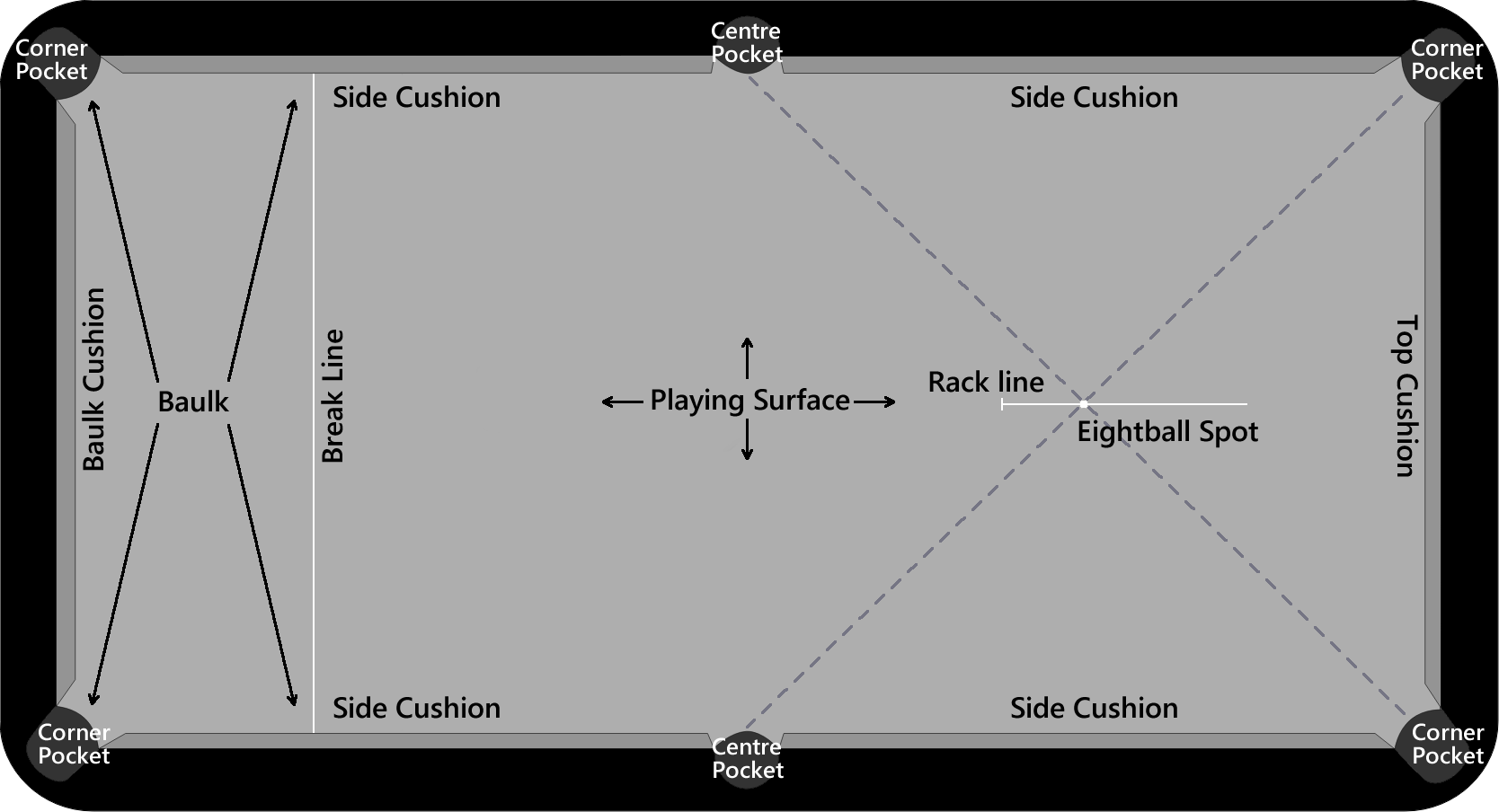
Pool table layout showing baulk, break line, cushions, corner and centre pockets, playing surface, rack line and eight-ball spot
Table layout. The eight-ball spot sits where the lines from each centre pocket to the opposite top corner pocket cross.

3. The Object of the Game

The match referee will enforce the flow of any match so that it is played in accordance with the strict process by which a frame is won. Players must also adhere to the same strict process.

4. The Lag & The Break

The Lag

Referees should ensure there are no other balls, and no racking triangle, on the table when the lag is about to start. Players should have access to the full top rail to hit and not be restricted.

The referee may swap players over if one is left-handed and the other right-handed, so neither player’s cueing is impeded. As a rule, the right-handed player lags on the left of the table and the left-handed player on the right.

Balls used for the lag, in order of preference: two cue balls, or a red and a yellow ball. Do not use a cue ball and a group colour together, as they differ in size and weight.

Players strike their balls simultaneously towards the top cushion on the referee’s indication. If one player’s ball strikes the top cushion before the other player’s ball is hit (not simultaneous), both players re-lag.

The Break

When counting points scored on the break, the referee should ensure that any ball counted is:

  • (a) Completely over the imaginary line drawn between the centres of the two centre pockets, or
  • (b) Pocketed.

An object ball that fully passes the centre line AND is pocketed only counts as 1 point.

Take care that no object ball is counted twice. For example, a ball can pass the centre line, hit the baulk cushion, hit the top cushion and return back over the centre line. The same applies to balls that pass the centre line, hit a cushion and are kicked or contacted back over the centre line a second time.

5. The Rack

When a referee is officiating, players may not rack the balls or check the rack after the triangle (or other racking device) has been removed. Players rack their own balls when no referee is present.

Referees should ensure the eight-ball is racked on the eight-ball spot, and that the balls are racked in the correct sequence.
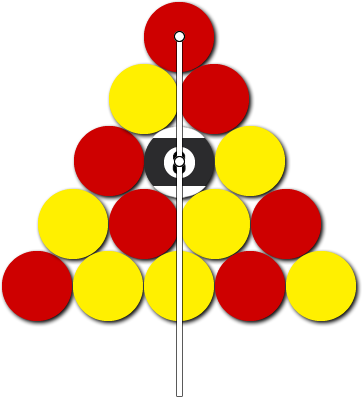
Correct racking sequence of red and yellow balls with the eight-ball in the centre of the third row
Correct racking sequence.

Referees may use their discretion when the balls are not tight enough or the head ball rolls away from the rack. In this case, rack the balls marginally higher or lower, to a maximum of 25mm or 1 inch (half an object ball’s diameter).

Players may not check any rack ‘close-up’ before the frame starts. If they see an obvious issue from where they stand at the baulk end of the table, they must tell the referee immediately.

6. In Play

6a. Deciding Groups

Definition: During an ‘open table’, an ‘obvious’ object ball that the cue ball makes initial contact with first becomes the ball ‘on’.

At any time during an open table, if a player pots an obvious object ball (the ball ‘on’) and the shot is not a foul, the referee verbally advises their group once all balls have come to rest.

While the table is open, if a player attempts to play an obvious object ball but misses it completely and the cue ball pots another ball of the same group they attempted, the player continues on that group. If the ball potted is from the opposite group, it is a ‘loss of turn’.

The referee should not request a group nomination when one is required, as this could be considered coaching. If a player calls a group when the table has an obvious layout, the referee calls ‘No nomination required’.

While the table is open, the eight-ball cannot be used as a ball ‘on’.

Once groups are decided, players cannot ask what group they are on. This would be deemed coaching.

6b. Continuing a Frame

A player is ‘in control’ of the table from the time all balls stop moving from the final shot of their opponent’s visit, to the time all balls stop moving from the final shot of their own visit.

6c. Combination Shots

Any attempted combination shot that fails to pot both the ball ‘on’ and an opponent’s ball results in a loss of turn, called as such by the referee.

Potting the eight-ball and then an opponent’s ball(s) is a legal shot and no penalty is awarded.

6d. Loss of Turn

Potting an opponent’s ball(s) without potting the ball ‘on’, having hit the ball ‘on’ first, results in a loss of turn. The opponent plays the cue ball from where it lies. Examples include an unsuccessful combination shot or a tactical/turnover shot.

On an open table:

  • If a player makes an obvious attempt (no need to nominate) to hit a specific group, misses it completely (no contact) and pots the opposite group, the referee calls ‘loss of turn’ and the table remains open.
  • If the cue ball makes initial contact with one group and the shot results in potting the opposite group only, the referee calls ‘loss of turn’ and the table remains open.
  • If the intended group is not obvious, a nomination is required. For example, playing towards a cluster, or towards balls of each group in close proximity, or failing to nominate when a touching ball has been confirmed. After the shot, the referee calls ‘loss of turn’ and the table remains open.
  • With no referee present, if a player calls one group but intentionally plays the opposite group to force a loss of turn, the player continues on the group potted. The nomination rule cannot be used to force a loss of turn.

Referee calls and actions

  • CALL: Loss of turn.
    ACTION: n/a

6e. Standard Fouls

As the rule states: “Shall be called as soon as they occur, the fouling player is in control until all balls from that shot have come to rest. The incoming player is awarded one visit and a cue ball in hand, which can be: a) Played from its current position, or b) Placed anywhere on the playing surface. The only exception to (a) is if the cue ball has come to rest and is touching an object ball and therefore must be repositioned.”

If a player has cue ball in hand after a foul, the cue ball is touching an object ball, and the player plays without repositioning it, a standard foul is given to the opponent under rule 6e(7): “Playing a shot before any balls that require re-spotting or replacing have been re-spotted or replaced”.

With a referee present: The instant the referee is aware of a foul, they make the appropriate call. When all balls have stopped, they call the penalty. The referee will recover the cue ball, offer it to the incoming player or place it on the playing surface against the baulk cushion, and call “Time Running”. If the incoming player asks for the cue ball to be left in position, the referee immediately calls “Time Running” and the player is still free to pick up the cue ball at any point.

After an “In-off”, the referee or player may recover the cue ball from the return box. The referee calls “Time Running” the moment the player’s hand is in the return box, even if the cue ball hasn’t arrived yet. If the player takes their time, the referee will recover the cue ball, place it against the baulk cushion and call “Time Running”.

With no referee present: Once the fouling player acknowledges the foul, the incoming player may pick up the cue ball or play it from where it lies. A loss of frame foul (rule 6f(9)) is awarded if the fouling player passes the cue ball to the incoming player, or the incoming player moves the cue ball before the foul is acknowledged.

The referee or opposing player must not stop a player who may be about to commit a foul. The action must take its course and a foul is called if committed. If two or more fouls occur in the same shot, the foul with the most severe penalty is called.

  • 6e(1) The cue ball falling into a pocket and remaining off the playing surface is an ‘in-off’. If the cue ball hits the back of the pocket and returns to the table, it is NOT an in-off.
  • 6e(2) A player positions the cue ball over the break line by more than 50% of its diameter.
  • 6e(3) Playing a shot when a player does not have the right to do so is playing out of turn. This can apply at any time during a frame.
  • 6e(4) A player may position the cue ball with the shaft of the cue when they have ball in hand. Only the tip may strike the cue ball to perform a legal shot. If the referee believes the breach was deliberate, consider whether the spirit of the game has been breached (rule 6f(2)).
  • 6e(5) Accidentally striking any object ball with any part of the cue, including the tip, is a foul. If deliberate, consider rule 6f(2).
  • 6e(6) No further advice needed.
  • 6e(7) No further advice needed.
  • 6e(8) Referees should be sure the words or actions can be interpreted as coaching. If suspected coaching causes a player to visibly alter their shot or change how they are looking at the table, or there is a definite instruction, the referee issues a first and final warning (if one has not already been given).
  • 6e(9) To leave the arena for a bona fide reason, a player must get permission from the referee (or opponent if no referee is present). Referees should not agree to excessive comfort breaks; competition rules may set the limit. Leaving the arena during a frame is generally not allowed unless agreed with the tournament director, for example for a medical reason.
  • 6e(10) A push shot can be determined when the cue ball, having struck the object ball, follows it in a similar direction AND at a similar speed when the balls were in close proximity before the shot, OR when the tip is still in contact with the cue ball after it has started its forward motion.
  • 6e(11) Seeing the cue follow through and/or hearing a double contact is not enough to make a call. It must be a visible contact.
  • 6e(12) See rule 6p ‘Legal Shot’. Potting or hitting an opponent’s ball first, for example when escaping a snooker, is deemed accidental unless it is clear and obvious the shot was deliberate, which carries the greater penalty of loss of frame.
  • 6e(13) The player must always have at least one foot on the floor, meaning the sole of the shoe touching the floor. The foot must be inside the shoe, not out of it and resting on top.
  • 6e(14) See rule 6o ‘Touching Balls’.
  • 6e(15) See rule 6l ‘Balls off the Table’.
  • 6e(16) No further advice needed.
  • 6e(17) A jump shot refers to the action of the cue ball on first striking. If the cue ball jumps but hits the object ball on the back, it is not a jump shot; the cue ball must completely clear the object ball. If the cue ball clears the object ball, hits a cushion and returns to hit that ball, it is a jump shot. If the cue ball first contacts a cushion and then jumps an object ball, it is also a jump shot. Once the cue ball’s first contact is with the intended ball, any balls jumped afterwards are not jump shots.
  • 6e(18) Deliberately marking the playing surface or cushions to assist a shot is a standard foul (e.g. chalk from the tip, a finger mark, or placing chalk or a coin in a strategic position). The referee should remove any marks or items. If the player persists, consider a breach of the spirit of the game.
  • 6e(19) See rule 6j ‘Shot Clock’.

Referee calls and actions

  • CALL: Foul, ball in hand.
    ACTION: Retrieve and offer the cue ball to the incoming player.
  • CALL: Time running.

6f. Loss of Frame Fouls

  • 6f(1) Prohibits deliberately striking an opponent’s ball first. This does not include accidents (miscues, missing a fine cut).
  • 6f(2) Not playing in the spirit of the game (unsporting behaviour), for example (but not limited to): (a) audible bad language for a second time after a warning; (b) excessive hitting of the table, physically or with a cue; (c) dismantling a cue or placing it in its case; (d) constant arguing with the referee or opponent, or refusing to accept the referee/senior referee’s decision; (e) gamesmanship, such as interfering with the opponent’s shot verbally or physically, jangling coins, noisily chalking, moving in the opponent’s eye line or making audible comments; (f) repeatedly marking the table; (g) deliberately trying to stop the cue ball going ‘in-off’ by any means. A player cannot assume an outcome will happen (the cue ball could jump back out of the pocket).
  • 6f(3) No further advice needed.
  • 6f(4) No further advice needed.
  • 6f(5) Prevents refusing to play a shot (including a deliberate time fail, but not any time foul; it must be deliberate) or playing a deliberate foul instead of a legitimate attempt to escape a snooker. If a player attempts the ball ‘on’ but leaves the cue ball well short, the referee may call it a deliberate act, for example to avoid disturbing balls near the ball ‘on’ to gain an advantage. If the referee cannot reach a definite conclusion, they should first warn the player that they cannot be 100% sure it was a poor enough attempt, and that a similar shot will result in loss of frame.
  • 6f(6) No further advice needed.
  • 6f(7) No further advice needed.
  • 6f(8) No further advice needed.
  • 6f(9) Given when: the fouling player passes the cue ball to the incoming player; the incoming player moves the cue ball before the foul is acknowledged; or a player deliberately moves any object ball, whether to gain an advantage or just having a laugh with friends.

Referee calls and actions

  • CALL: Foul, loss of frame.
    ACTION: Proceed to rack the balls for the next frame.

6g. Stalemate Situation

Players must always ask for a stalemate if they believe one exists. The rule is clear: “if there is no path ‘out’ for the cue ball or no path ‘into’ the ball ‘on’ in order to play a legal shot, a stalemate is given”.

However ridiculous an escape may be, the shot is never impossible, only improbable. The referee will not apply the ‘laws of physics’ or consider a player’s ability. Judgement is based solely on the rule.

Referee calls and actions

  • ACTION: Call timeout and evaluate the table as to whether a shot is possible for the incoming player.
    CALL: Stalemate / No stalemate, time running.

6h. Frozen Balls

For frozen balls there are six cushions: baulk cushion, top cushion, left-hand side top, left-hand side baulk, right-hand side top and right-hand side baulk.

If a frozen ball, when struck, leaves its cushion and returns to the same cushion without touching another cushion, it is NOT a legal shot, unless:

  • (a) The frozen ball contacts an object ball, forcing that ball into a cushion, or
  • (b) The cue ball contacts a cushion after contact with the frozen ball, or
  • (c) The cue ball, after contacting the frozen ball, misses the cushions but contacts an object ball, forcing it into a cushion.

A simultaneous contact between a frozen ball and the cushion it is frozen to is NOT a legal shot.

If both the object ball and cue ball are frozen to the same cushion, then:

  • (a) A ball ‘on’ must be potted, or
  • (b) Either the cue ball or frozen ball must contact a different cushion, or
  • (c) Any other object ball must be caused to contact any cushion.

Referee calls and actions

  • ACTION: Call timeout and evaluate the frozen ball(s).
    CALL: Frozen ball.
    ACTION: Indicate which ball is touching the cushion.

6i. Outside Interference

Everything in the rules is clear and concise. Note: if the interference was deliberate, the players and spectators receive a first and final warning. If it happens again, the person will be disqualified from the competition or removed from the venue.

6j. Shot Clock

All calls are made clearly and audibly for the benefit of players and spectators.

A ‘time foul’ is called when the audible signal for zero sounds AND the player has not made contact with the cue ball. If a manual stopwatch is used, the timekeeper calls ‘time foul’ at zero.

If the referee has any doubt about a close time foul, they should consult TV replays (if available) or give the benefit of the doubt to the player at the table.

After a time foul, the shot clock or stopwatch is not reset and started for the incoming player until ‘time running’ is called. If balls need re-spotting, the clock does not start until the referee calls ‘time running’, with both players remaining seated until then.

If a VDU (visual display unit) shows the score, shot clock and extensions, the player should not be penalised if the timekeeper fails to update it or there is a computer malfunction.

Stopwatch (if used): timekeepers should not stare at the stopwatch to the detriment of their other duties. If the five seconds call is made late, the player still gets five seconds from when the call is made.

The shot clock for the incoming player normally starts the instant the referee decides all balls have stopped moving, and stops the moment the cue ball is struck.

6k. Balls Falling into a Pocket

Any balls that drop before a shot starts are replaced to their original position. The referee may need to call a timeout to do this. The player should not lose shot clock time; pause the clock and restart it when the referee calls ‘time running’.

Any balls that drop during a shot, when not part of the shot (or would have been played but dropped before contact), are replaced and the player continues with no penalty. If the dropped ball would have been played as part of the shot, ALL balls are replaced to their original positions, resetting the shot. The player may attempt the same shot or choose a different one, with no penalty.

If the match is broadcast, the referee may ask the production crew for a freeze frame of the ball positions. If both players are not satisfied, the referee must make further attempts to satisfy them. A re-rack can only be granted by the referee if they feel they cannot return the balls to their original positions. A player cannot enforce a re-rack.

6l. Balls off the Playing Surface

The playing surface is the flat surface between the cushions.

At ANY point in a frame (break or in play), if a ball leaves the playing surface and does not return of its own accord, it is a standard foul and the ball(s) are re-spotted (rules 6e(15), 6l and 6m).

A ball that leaves the playing surface must return of its own accord. If it contacts an object (not part of the table) or a person and then returns, a standard foul is called. If it leaves the playing surface, runs along a cushion and returns (or is potted if a ball ‘on’), it is not a foul.

A ball is deemed ‘pocketed’ if: (a) it falls into a pocket, or (b) it sits over a pocket so that, although touching the playing surface, the centre point of the ball is over the pocket and not on the playing surface.
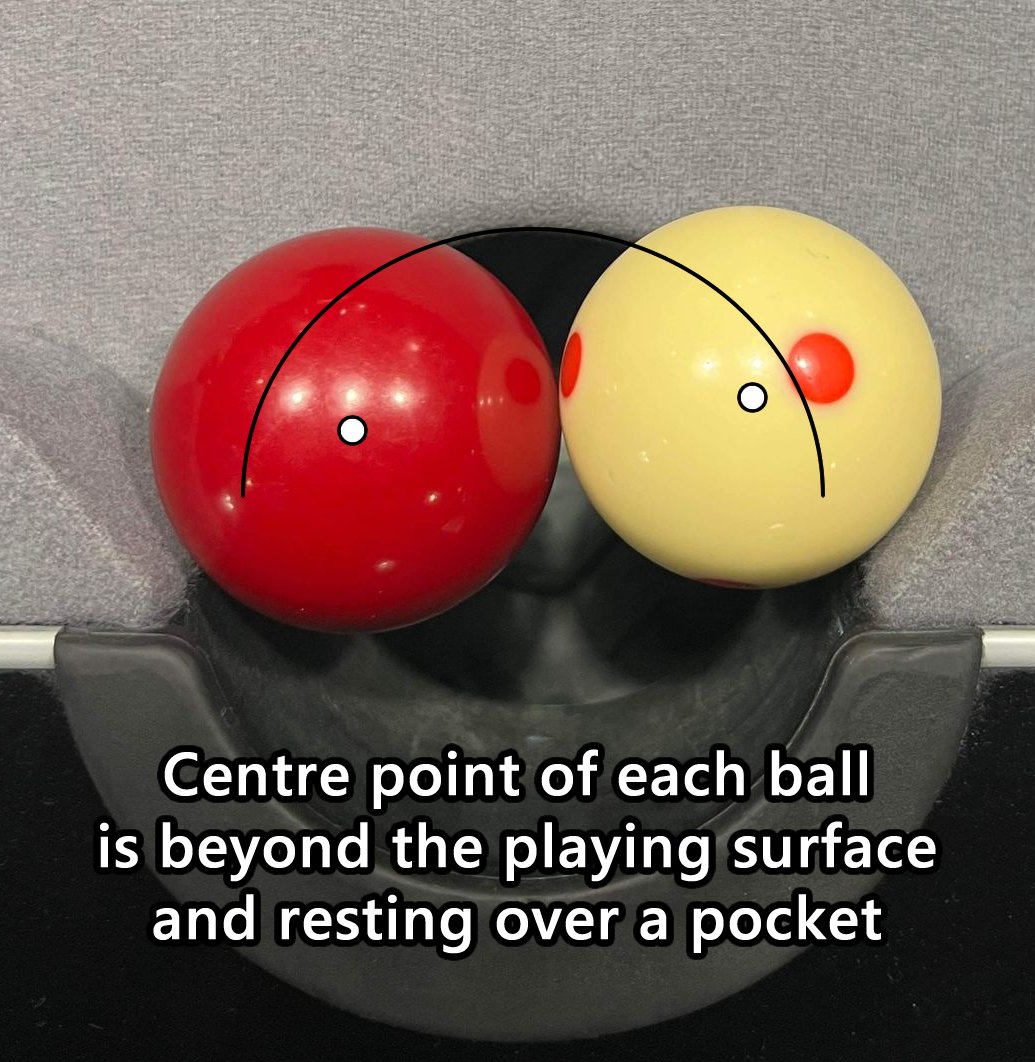
A red ball and a cue ball resting over a pocket, with the centre point of each ball beyond the playing surface
Deemed pocketed: the centre point of each ball is beyond the playing surface and resting over a pocket.

6m. Re-spotting Balls

Object balls that remain off the table are returned to the eight-ball spot, or as close as possible to it in a direct line towards the top cushion. If there is no space between the spot and the top cushion, place them in a direct line from the eight-ball spot towards the baulk cushion. Place balls as close as possible to other balls without touching them.

When returning multiple balls, the order is: eight-ball first, reds second, then yellows.

6n. Players’ Responsibility

If a player asks for clarification of a rule, the referee must be aware of whether the answer could affect the shot the player is considering. Choice of shot is the player’s responsibility, and the referee’s advice cannot affect the outcome of a shot or frame. Clarification must not be construed as coaching. Clarification is requested in the player’s own time; no timeout is granted.

Players must not approach the table during a timeout, as this would gain an advantage while no shot clock is running. The referee should first warn the player and ask them to stay seated. If they do it again, the referee may award the frame to the opponent for gamesmanship (rule 6f(2)).

6o. Touching Balls

The referee (or player if no referee is present) calls all touching balls.

A player must play away from ALL touching balls at an angle of 90 degrees (perpendicular) or greater. A touching ball that rocks or moves slightly because it was resting on the cue ball is not a foul if played away at greater than 90 degrees.

On an open table, a touching ball requires the player to call a group to clarify the intended shot. The call does not set the group for the rest of the frame; only the first legal ball potted does that. If no call is made, a loss of turn is called regardless of the outcome.

A player must always attempt a legal shot, whatever the situation. Two elements are needed:

  • (a) Strike the ball ‘on’ first, AND THEN
  • (b) Pot a ball, or another ball indirectly (except the eight-ball if not ‘on’), OR cause the cue ball or any object ball (including the eight-ball if not ‘on’) to contact a cushion.

During an open table, the ball ‘on’ is the first ball contacted for the purposes of a legal shot.

For ‘contacting a cushion’, the six pockets count as cushions. This covers object balls that are potted and jump back out onto the playing surface without any ball contacting a cushion.

6q. Simultaneous Contact

Simultaneous contact is allowed as long as one of the contacted object balls is ‘on’.

On an open table, simultaneous contact requires the player to have nominated a group (because the shot is not obvious, rule 6a(5)), which declares the intended group as the ball ‘on’. If no nomination was made before the shot, the referee calls loss of turn (rule 6d(4)).

7. Completion of a Frame

The frame is complete when a player pockets the eight-ball legally and all balls have come to rest. The referee calls ‘Frame’ to indicate the frame has finished, then proceeds with the normal steps to start the next frame or allows a comfort break. The referee may use this time to speak with the senior referee on any matter, but must tell the players beforehand.

Annex A: Timeouts or Play Halted

During a timeout or stoppage, neither player is in control of the table. Referees should ensure both players stand or sit away from the table. If a player takes a shot or involves themselves in the frame during a timeout, they are deemed to have played out of turn and a standard foul is called. Timeouts are at the referee’s discretion.

A timeout may be called when:

  • (a) A player requests a rest or bridge
  • (b) Something or someone is obstructing the player
  • (c) The referee has to make a decision or call in a senior referee
  • (d) The referee has to replace or re-spot a ball
  • (e) A player sustains an injury needing medical attention or a few minutes to recover

Some of these can be overruled by tournament/competition rulings. Referees must know all relevant tournament rulings.

Timeouts will NOT be granted for:

  • (a) Cleaning a ball (can be done in the player’s own time)
  • (b) A toilet break
  • (c) Searching for a dropped item
  • (d) Fetching refreshments

Annex B: Glossary of Terms

  • Push Shot: A shot where the cue tip stays in contact with the cue ball until the cue ball touches the object ball (see 6e(10)).
  • Table: Collective term for the carcass, slate, cloth, rails and pockets.
  • Playing Surface: The slate and cloth; the area that houses the balls in play.
  • Cushions: Also known as rails. Six per table, between each pocket.
  • Pockets: Also known as bags or holes.
  • Break Line: A straight line across the width of the playing surface marking the end of the baulk area.
  • Baulk: The area you break from, normally 1/5th the length of the playing surface.
  • Baulk Cushion: The cushion parallel to the break line, used as the reference for the lag. Also known as the bottom cushion.
  • Top Cushion: The cushion opposite the baulk cushion, normally where the balls are racked before being moved into position.
  • Frozen Ball: Any object ball touching a cushion.
  • Touching Ball: Any object ball the cue ball is touching.
  • Open Table: No groups decided; a player may play at any group.
  • Combination Shot: Potting your own ball and an opponent’s ball in a single shot. Your group must be hit first.
  • Tactical Shot: Hitting your own group first then potting an opponent’s ball, with no attempt to pot your own, to gain an advantage.
  • Rack: The initial triangle formation of balls before the frame starts.
  • Nap: The directional grain of the cloth. Smooth when brushed from baulk to top cushion, resistant the other way.
  • Ball ‘On’: Any ball from your group, including the eight-ball once your group is potted, during your visit.
  • Visit: Also known as turn. When you are in control of the table and your opponent is not.
  • Pot: Making a ball fall into one of the six pockets.
  • Frame: A single game of pool.
  • Match: Multiple frames of pool.
  • Extension: Additional time given to extend the original shot time.
  • Concession: A player gives up the match and loses it. The referee must see or hear something to conclude the match, e.g. shaking hands, throwing a towel on the table, or verbally conceding.
  • In-Off: The cue ball is potted during a shot.

Source: Referee’s Guidance, Revision 2d (Jan 2026). Copyright © International Referees Organisation 2026.

International Eight Ball Rules Quick Start

quick start guide jan 26

QUICK START GUIDE (Rev 2d Jan 2026)
INTERNATIONAL EIGHTBALL RULES

In summary…

  1. Players must lag to decide who breaks first.
    See Rules 4a, 4b, 4c & 4d
  2. When breaking, one point is scored for a pot or if an object ball completely crosses the imaginary line between the centre pockets when the break is played according to a three-point regulation. A ball that crosses the imaginary line and is subsequently pocketed is worth one point.
    See Rule 4f
    The flowchart at the end of this document will describe the sequence of events for most scenarios/outcomes with regard to the break.
    Copyright © International Referees Organisation 2026
  3. The table is OPEN following the break; the first ball to be potted legally decides the group; if a player pots one of each group in the same shot, the choice of group will be regarded as the group that was struck first.
    See Rule 6a (2) & 6a (4)
  4. What is regarded as a LOSS OF TURN? Accidentally potting an opponent’s ball OR failure to execute a successful combination shot OR Contacting the ‘on’ ball first then potting an opponent’s ball (Referred to as a ‘Tactical shot’). The Incoming player must always play the cue ball from its current position.
    See Rule 6d
  5. Failure to make a genuine attempt to play a shot is ‘LOSS OF FRAME’.
    See Rule 6f (5)
  6. All ‘standard fouls’ are ‘cue ball in hand’ and can be played in situ (unless touching ball) or placed anywhere on the playing surface.
    See Rule 6e
  7. If an object ball is potted or any object ball strikes a cushion after contact with the ball ‘on’, it is considered a ‘legal shot’.
    See Rule 6p
  8. A stalemate is only guaranteed when no legal shot can be played, in other words, if there’s a gap for the cue ball and ball ‘on’, you play the shot. A stalemate will result in a re-rack and the original breaker restarts the frame.
    See Rule 6g
  9. A frozen ball MUST be confirmed by the players or a referee before any shot can be played where the frozen ball may be contacted directly as the ball ‘on’.
    See Rule 6h
  10. When a match is timed – each player has 45 seconds to play a shot. At 5 seconds remaining a countdown will begin. If the time elapses and the cue ball has not been struck, a ‘time foul’ will be called. Each player will be given one time extension per frame.
    See Rule 6j
  11. A frame is over when the eight-ball is potted on a ‘legal shot’. All the group colours of the player at the table must have been potted before attempting a shot at the eight-ball.
    See Rule 6f (4) & Rule 7 Copyright © Internationa

The International Eight Ball Pool rules are played at the World Eightball Pool Federation Championships (WEPF) and the Australian Eight Ball Federation Championships (AEBF).

QUICK START GUIDE (Rev 2d Jan 2026)
INTERNATIONAL EIGHTBALL RULES
http://aebf.asn.au/wp-content/uploads/sites/11/2026/10/International-Eightball-Rules-QUICK-START-GUIDE.pdf

International Eight Ball Rules Calls

calling procedures jan 26

Calling Procedures, International Eightball Rules (Revision 2d – January 2026). Endorsed and recognised as the official calling procedures by the International Eightball Pool Federation (IEPF).

The intention of the document is to offer referees guidance and a clear structure on how to referee a match. Players may also wish to read this so they are familiar with the calling procedures of a referee. The purpose of this guide is to reduce the referee’s involvement in a match mainly aided by the simple, but effective, international eightball rules.

Before the start of any match, it is expected that a referee shall know the official rules of pool (International eightball rules) used in the competition/tournament and also any further additional rules set out by the tournament director.

You are to be responsible for upholding:

  • The dress code required under the competition/tournament before the players enter the arena. If there is anything you are unsure of or is borderline, refer the matter to the tournament director.
  • You should also be aware/vigilant of any form of intoxication, mostly drugs/alcohol but not limited to. Again refer this issue to the tournament director.
  • The laws/rules that govern the game of pool.

Players can request a sensible amount of comfort (toilet or drink) breaks during a match. The comfort breaks must not be used for cigarettes or meals – you should deny the request.

Notes:

  • Your call is in bold
  • Words in ‘Italics’ are guidance to making a call.
  • Where highlighted in (red) replace with what is being suggested when making your call
  • Where highlighted in (red) AND has a “/” omit the incorrect word for the statement you are calling.

1. The start of the match

CALL: Count the players in: 3, 2, 1, lag
Upon deciding a winner of the lag CALL: (player name) wins the lag.
Proceed to rack the balls for the first frame and offer the cue ball to the incoming player.
CALL: 1st frame, (player name) to break.

2. During the match, thereafter the first frame

CALL: Frame number (frame number), (player name) to break, (trailing/leading) by (match score).
Or
CALL: Frame number (frame number), (player name) to break, (x) frame/s all.

3. Legal break, no balls potted/balls potted

No call is required.

4. Eight-ball potted on the break shot (legal break, balls potted/no balls potted)

CALL: Timeout, re-spot the eight-ball on the black spot or as close as possible without touching other balls, in a straight line towards the centre of the top cushion, CALL: time running.

5. Foul break

CALL: Foul break, re-rack the balls and ask the incoming player whether they wish to break or turnover the break to their opponent. Offer the cue ball to the incoming player, CALL: Frame number (frame number), (player name) to break.

6a. Cue ball potted (legal break)

CALL: Foul, ball in hand from baulk, retrieve and offer the cue ball to the incoming player, CALL: time running.

6b. Cue ball leaves playing surface (legal break)

CALL: Foul, ball in hand, retrieve and offer the cue ball to the incoming player, CALL: time running.

7a. Legal break, Balls potted (obvious group choice)

No call is required.

7b. Legal break, Balls potted (obvious group choice, player nominates)

If you agree with the player’s nomination, CALL: (Yellows/reds) nominated.
If you disagree with the player’s nomination, CALL: No nomination required.
This is to stop players from abusing the nomination rule where they create a deliberate ‘loss of turn’ situation. For example, obvious red, player nominates red, player proceeds to pot a yellow.

7c. Legal break, Balls potted (No obvious group choice, player nominates)

CALL: (Yellows/reds) nominated.

7d. Legal break, Balls potted (No obvious group choice, player fails to nominate)

CALL: Loss of Turn, after the shot is played.

8. Decided groups (First instance only)

CALL: (Yellows/reds) in play.

9. Standard fouls (Open table & groups decided)

CALL: Foul, ball in hand, retrieve and offer the cue ball to the incoming player, CALL: time running.

10. Tactical shot/Unsuccessful combination shot

CALL: Loss of turn.

11. Loss of frame foul

CALL: Foul, loss of frame. Proceed to rack the balls for the next frame.

12. When timing a frame (Referee timing frame)

Players are allowed a set amount of time per shot. When the timer gets down to five seconds…
CALL: 5, 4, 3, 2, 1 and if the player fails to strike the cue ball at the end of the countdown call…
CALL: Time foul, ball in hand, Standard foul applies. Retrieve and offer the cue ball to the incoming player, CALL: time running.

13. Time extension

Players are allowed one time extension per frame.
If a player calls for an extension and has one available:
CALL: Extension called
If a player calls for an extension and has no remaining available:
CALL: No extension remaining

14. Timeout (required/requested)

CALL: Timeout, deal with the issue, CALL: time running.

15. Touching ball (All instances)

CALL: Touching ball, with an indication as to which ball(s) the cue ball is touching.

16. Frozen ball

CALL: Frozen ball, with an indication as to which ball is touching the cushion.

17. Stalemate (As requested by the player)

CALL: Timeout, evaluate the table as to whether a shot is possible for the incoming player, CALL: (Stalemate / No stalemate, time running)

18. Completion of a frame

CALL: Frame. Proceed to rack the balls for the next frame.

19a. Completion of a frame AND match

CALL: Frame and match (Players Name), shake hands with the players and remove all the balls from the playing surface.

19b. Completion of a match when the match time has expired

  • Winner by higher frame count:
    CALL: Match (Players Name), shake hands with the players and remove all the balls from the playing surface.
  • Scores tied: (6 red shoot-out in use)
    CALL: Match drawn, 6 red shoot-out, retrieve a red and yellow ball then remove all remaining balls from the playing surface ready for the players to lag for the right to choose who goes first and second in the shootout.
  • Upon scores tied: (draws allowed)
    CALL: Match drawn, shake hands with the players and remove all the balls from the playing surface.

Copyright © International Referees Organisation 2026

International Eight Ball Rules CallsThe International Eight Ball Pool rules are played at the World Eightball Pool Federation Championships (WEPF) and the Australian Eight Ball Federation Championships (AEBF).

International Rules v2d (Jan 2026) Referee Calling Procedures
http://aebf.asn.au/wp-content/uploads/sites/11/2026/10/International-Eightball-Rules-CALLING-PROCEDURES.pdf

6 Red Shootout: For the referee guidance on calling a 6 red shootout, click here.